
Where is China Situated?
China is located in East Asia and is one of the largest countries in the world by land area. It shares borders with countries such as India, Russia, and Pakistan.
The country has direct access to the Pacific Ocean, which strengthens its global trade network. Its capital is Beijing, while Shanghai and Shenzhen are key economic centers.
Why China is Famous in Industry
China has built a global reputation as an industrial powerhouse due to several key reasons:
- Large-scale manufacturing across electronics, machinery, and consumer goods
- Strong export economy supplying products worldwide
- Rapid advancement in technology, AI, and digital platforms
- Leadership in electric vehicles and battery production
- Government-backed infrastructure and industrial policies
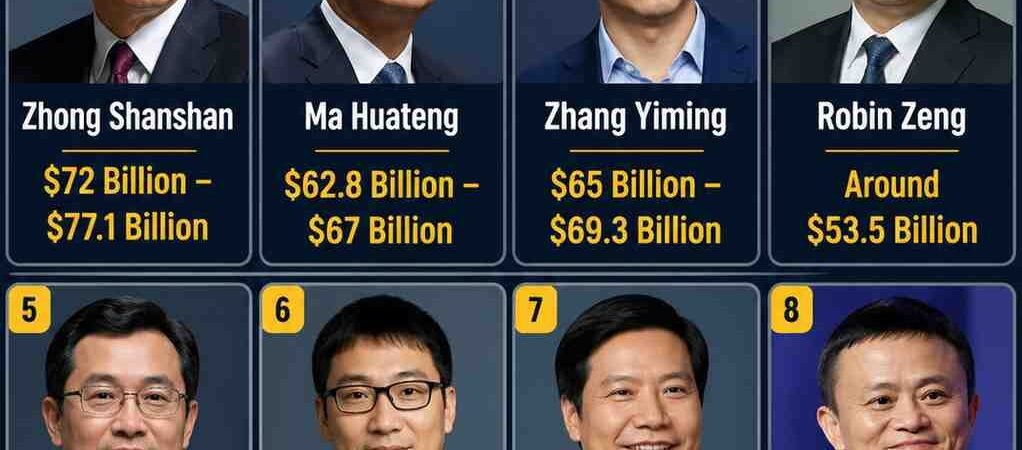
Top Chinese Business Leaders (2025–2026 Rankings)
- Net Worth: $72 Billion – $77.1 Billion
- City: Hangzhou
- Country: China
- Source of Income: Nongfu Spring (bottled water), pharmaceuticals
- Status: Richest person in China in 2026
2. Ma Huateng
- Net Worth: $62.8 Billion – $67 Billion
- City: Shenzhen
- Country: China
- Source of Income: Tencent (WeChat, gaming, fintech)
3. Zhang Yiming
- Net Worth: $65 Billion – $69.3 Billion
- City: Beijing
- Country: China
- Source of Income: ByteDance (TikTok), artificial intelligence
4. Robin Zeng
- Net Worth: Around $53.5 Billion
- City: Ningde
- Country: China
- Source of Income: CATL (electric vehicle batteries)
5. William Ding
- Net Worth: $44 Billion – $47.5 Billion
- City: Hangzhou
- Country: China
- Source of Income: NetEase (online gaming, internet services)
6. Colin Huang
- Net Worth: Around $45.3 Billion
- City: Shanghai
- Country: China
- Source of Income: PDD Holdings (Pinduoduo, Temu e-commerce)
7. Lei Jun
- Net Worth: Around $36.8 Billion
- City: Beijing
- Country: China
- Source of Income: Xiaomi (smartphones, electronics, EV expansion)
8. Jack Ma
- Net Worth: Around $31 Billion
- City: Hangzhou
- Country: China
- Source of Income: Alibaba Group, fintech investments
Key Industries and Trends in China
- Technology and AI: Dominated by companies like ByteDance and Tencent
- Electric Vehicles: Strong growth through companies like CATL and BYD
- E-commerce: Rapid expansion led by Alibaba and PDD Holdings
- Manufacturing: Continued global leadership in production and exports
Importance of China in World Import and Export
China is not just another trading nation—it is the center of global trade activity. Almost every country in the world either buys from China, sells to China, or depends on Chinese production in some way. Its role is so large that even small changes in China’s economy can affect global markets.
1. China as the Manufacturing Heart of the World
China has built a reputation as the “world’s factory.” This didn’t happen overnight. Over decades, China invested in factories, skilled labor, and infrastructure.
Today, products like:
- Mobile phones
- Home appliances
- Clothing and textiles
- Industrial machinery
are produced in huge volumes and exported worldwide.
Cities such as Shenzhen and Guangzhou have become global production centers where goods are made quickly and efficiently.
2. Strong Export Power and Global Reach
China consistently ranks as the largest exporter in the world. Its goods reach markets in Asia, Europe, Africa, and the Americas.
One major reason for this success is:
- Lower production costs compared to many countries
- Fast production speed
- Ability to handle large orders
Major ports like Shanghai play a key role in shipping millions of containers every year, connecting China to global markets.
3. China as a Huge Buyer (Importer)
China’s importance is not only because of exports—it is also one of the biggest buyers in the world.
To keep its industries running, China imports:
- Oil from Saudi Arabia
- Iron ore from Australia
- Agricultural products from Brazil
This makes China a lifeline for many exporting countries, as their economies depend on Chinese demand.
4. Control Over Global Supply Chains
China plays a central role in global supply chains. In simple terms:
- Raw materials are imported into China
- Products are manufactured in Chinese factories
- Finished goods are exported to other countries
Many international brands rely on China for production. If supply chains in China slow down, it can cause shortages and price increases worldwide.
5. Influence on Prices and Global Markets
Because China produces and consumes so much, it has a strong impact on global prices.
- If China exports more goods, prices may drop globally
- If China imports more raw materials, global prices may rise
This influence makes China a key player in global economic stability.
6. Leadership in New Industries
China is no longer only about traditional manufacturing. It is now leading in modern industries such as:
- Electric vehicles and batteries
- Solar panels and renewable energy
- E-commerce and digital platforms
Chinese companies are exporting advanced technology products, not just basic goods.
7. Trade Connectivity and Global Projects
China has expanded its global trade network through initiatives like the Belt and Road Initiative.
This project builds roads, railways, and ports across multiple continents, making trade faster and easier between countries.
8. Importance for Developing Countries
China plays a very important role in developing economies:
- Provides affordable products
- Buys raw materials
- Invests in infrastructure
For example, Pakistan benefits through trade and projects like CPEC, which improve transport and business opportunities.
9. Trade Surplus and Economic Strength
China usually exports more than it imports, which creates a trade surplus. This helps the country:
- Build strong foreign exchange reserves
- Maintain economic stability
- Invest in global projects
Conclusion
China’s strategic location, combined with its powerful industrial system and fast-growing technology sector, has made it a dominant global economy. The country’s top business leaders are shaping industries such as AI, e-commerce, gaming, and electric vehicles, influencing markets far beyond China.