
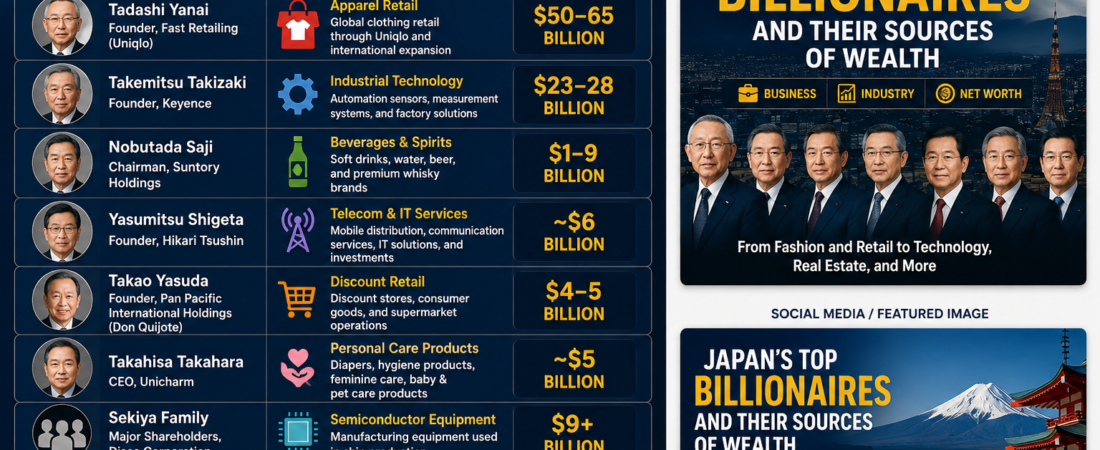
Japan has produced some of the most powerful business figures in the world, and their wealth is built from industries that shape everyday life—fashion, technology, retail, beverages, telecom, real estate, and advanced manufacturing.
At the center of Japan’s modern retail transformation is Tadashi Yanai, the founder of Fast Retailing and Uniqlo. He turned a small clothing shop into a global fashion powerhouse by focusing on simple designs, affordable pricing, and large-scale international expansion. His estimated net worth is between $65 billion and $73 billion, mainly from global apparel retail and brand ownership.
What makes his success interesting is not just the size of Uniqlo, but the consistency of its growth. Even during global economic slowdowns, the brand continued expanding across Asia, Europe, and the United States, showing how strong operational systems can build long-term wealth.
In the field of industrial technology, Takemitsu Takizaki built his fortune through Keyence, a company known for automation sensors, measurement tools, and advanced factory equipment. His wealth comes from supplying critical technology used in manufacturing industries worldwide. His estimated net worth is around $23.6 billion and $28.4 billion, driven by global demand for automation and smart factories.
The beverage industry in Japan has also created major fortunes. Nobutada Saji leads Suntory Holdings, a company producing soft drinks, mineral water, beer, and internationally famous whisky brands. His income is connected to global beverage sales and brand expansion, with an estimated net worth ranging from $9.3 billion depending on family holdings and company value.
In telecommunications and IT services, Yasumitsu Shigeta built Hikari Tsushin into a strong business focused on mobile distribution, communication services, and technology solutions. His wealth mainly comes from telecom networks, IT sales, and diversified investments. His net worth is estimated at around $5,8 milliards USD.
Retail innovation in Japan is strongly linked to Takao Yasuda, the founder behind Pan Pacific International Holdings, known for Don Quijote stores. His income comes from discount retail, consumer goods, and large-scale supermarket operations. His estimated net worth is $4–5 billion, built on high-volume sales and mass-market retail strategy.
The personal care industry is another strong pillar of Japan’s economy, represented by Takahisa Takahara, the leader of Unicharm. The company produces diapers, feminine hygiene products, baby care items, and pet care goods. His wealth comes from global consumer demand, with a net worth of around $5 billion.
A major part of Japan’s technological strength is the semiconductor industry, where the Sekiya Family holds significant wealth through Disco Corporation. The company manufactures precision equipment used in chip production. Their fortune is estimated at $9 billion+, driven by global semiconductor demand.
In retail heritage, the Ito Siblings are connected to the legacy of Ito-Yokado and Seven & i Holdings. Their wealth comes from convenience stores, supermarkets, and large retail chains across Japan. Their net worth is estimated at $4–5 billion.
Real estate remains one of Japan’s most stable wealth sources, and Akira Mori is a major figure in this sector. Through Mori Trust, he owns and develops office buildings, hotels, and commercial properties in key urban locations. His estimated net worth is around $4 billion+, supported by long-term property investments.
Together, these business leaders show how different industries in Japan create massive wealth in different ways. Some rely on global branding, others on technology, infrastructure, or consumer demand, but all of them share one thing—long-term vision combined with consistent execution.